
AI
Four kinds of AI agent in finance. Is there a fifth?
If you lead a finance team, you've probably been shown a few AI agents this year. Each one sees what the system it was built in sees. That's its strength — and it's where the gaps appear. Here's how to tell which will actually help.
Every vendor has an agent now
2026 is the year every finance software vendor ships an AI agent. Your ERP vendor has one. Your reconciliation tool has one. Your AP automation platform has one. The productivity suite your company already uses has one too.
The demos are impressive. Natural language queries. Automated exception handling. Intelligent recommendations. The promise is consistent: let the agent handle the routine so your team can focus on judgment.
But finance leaders are asking a harder question: which of these will actually take work off my team? Not which demo is smoothest. Not which vendor has the best pitch. Which one will change how Monday morning feels.
After watching dozens of these demos and talking to finance teams who've piloted them, a pattern has emerged. The question that separates useful AI in finance from impressive demos isn't which agent is smartest. It's what each agent can see.
The problem isn't volume. It's the space between systems.
Consider what happens in a typical cash application process. A matcher clears 328 of 340 bank lines before anyone logs in. That's automation earning its keep. Twelve are left. That's where the morning goes.
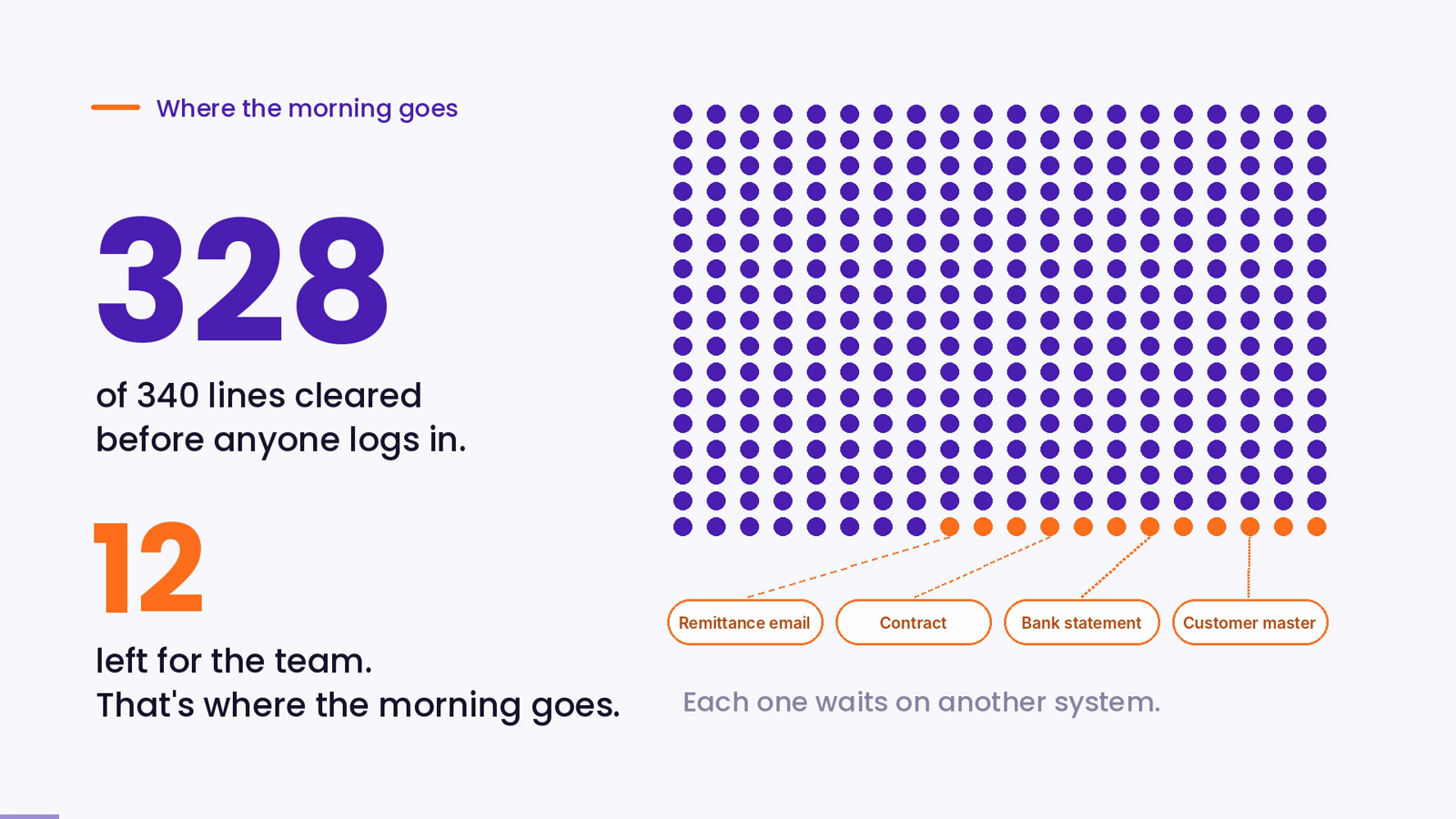
Here's what most people miss: none of those twelve is actually a matching problem. The algorithm didn't fail. Each exception is waiting on context that lives somewhere else entirely.
- One needs a remittance email the customer sent to a sales rep, never forwarded to finance
- Another requires checking a contract clause that explains a 2% early-payment discount
- A third involves a bank statement line that posted to the wrong subsidiary account
- Two more depend on customer master changes that happened last week but haven't synced
The matching engine did its job. The twelve remain because their resolution requires crossing system boundaries that no single tool was designed to cross.
This is the architectural reality most agent pitches skip over. The hard exceptions aren't hard because they need more intelligence. They're hard because the context needed to resolve them is fragmented across systems that don't talk to each other.
How a single error becomes three problems
Before evaluating any agent, it helps to trace how a problem actually moves through finance operations. Here's a scenario we've seen repeatedly:
Day 3: A $48,000 receipt arrives. The cash application system matches it to Customer A, who has an open invoice for $48,000. Clean match, auto-posted. Except the payment was actually from Customer B — similar name, different entity, also with a $48,000 invoice. The matching confidence was 94%. The system did exactly what it was designed to do.
Day 5: Collections runs its daily workflow. Customer B shows an invoice 30 days past due. An automated reminder goes out: *Please remit payment for Invoice #4472.* Customer B replies, confused and annoyed — they paid two days ago.
Day 8: A sales rep forwards the customer complaint to AR. Someone investigates, finds the misapplication, reverses the receipt, reapplies it correctly. The immediate problem is fixed. But no one updates the collections system's contact history. No one flags the reconciliation that's about to break.
Day 25: Month-end reconciliation surfaces a $48,000 timing difference on Customer A's account. Three hours of investigation later, someone traces it back to the reversal on Day 8. The break is explained, but explaining it required reconstructing a sequence of events across three systems that don't share context.
Each tool did its job correctly. Cash application matched on the data it had. Collections chased what looked overdue. Reconciliation found the difference. No tool got anything wrong. The cause sat between them.
This is the real test for any AI agent: not whether it can handle routine matching, but whether it can see the $48,000 receipt, the collection reminder, and the reconciliation break as one problem with three symptoms rather than three unrelated exceptions in three different systems.
Four kinds of agent — and where each falls short
The simplest way to evaluate AI agents is to ask where each one was born. An agent tends to see what the system it was built in sees. That's its strength. It's also its constraint.
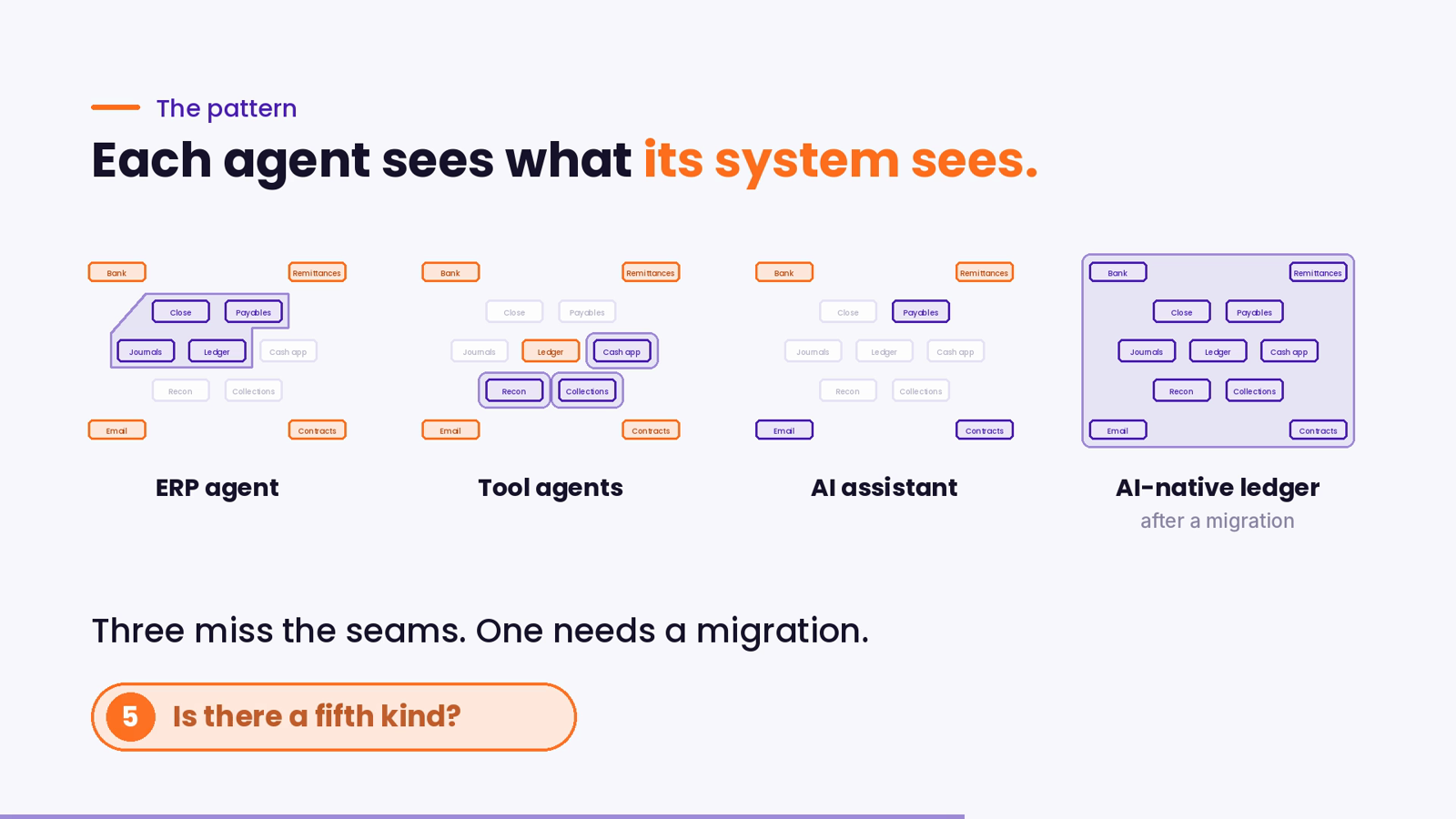
1. ERP agents: strong on control, blind outside the ledger
ERP agents are built by companies like SAP, Oracle, and Microsoft Dynamics. They live inside the system of record. They understand your chart of accounts, your approval hierarchies, your posting rules, your period-end controls.
This is a genuine strength. When you ask *What's the accrual balance for legal fees?* or *Which journals posted to this cost center last month?*, the ERP agent can answer authoritatively. It works within your existing controls, which matters for audit and compliance.
The limitation becomes clear when exceptions require context the ERP doesn't have. The $48,000 misapplication looks fine in the ledger — a receipt was posted, a receivable was cleared. The ERP agent can't see the remittance email that would have revealed the customer name mismatch. It can't access the bank statement narrative. It doesn't know about the collection complaint sitting in a sales rep's inbox.
The pattern: ERP agents excel at questions about what's already recorded. They struggle with questions about why something is wrong, because the why often lives outside the ledger.
2. Tool agents: deep in one process, gaps between
Specialist tool agents come from vendors like BlackLine, HighRadius, Celonis, and dozens of others. Each knows its domain thoroughly. A reconciliation agent understands matching rules, variance thresholds, certification workflows. A cash application agent knows remittance parsing, customer matching algorithms, dispute handling.
Within their domain, these agents can be remarkably capable. A good cash application agent might raise match rates from 75% to 92%. A good reconciliation agent might cut certification time in half. They're purpose-built for specific workflows, and it shows.
The limitation is architectural. Each agent sees its own process but not the others. The cash application agent that misapplied the $48,000 has no visibility into collections. The reconciliation agent that surfaced the break has no context about the reversal that happened three weeks earlier. When a problem crosses process boundaries — and the hard problems almost always do — each agent sees only its fragment.
The pattern: Tool agents go deep in one workflow. But finance isn't a collection of isolated workflows. It's an interconnected operation where upstream actions create downstream consequences. The gaps between tools are where problems hide.
3. AI assistants: great at explaining, not at doing
Enterprise AI assistants — Copilot, Gemini, internal ChatGPT deployments — represent a different architecture. They're designed for understanding rather than action. Connect them to your data sources and they can answer questions across systems: *Why did opex rise $182K this month?* The assistant pulls from the GL, the AP subledger, the contract database, and synthesizes a narrative.
For ad-hoc analysis, this is powerful. A CFO preparing for a board meeting can get variance explanations in minutes instead of hours. A controller investigating an unusual balance can query across data sources conversationally. Understanding is genuinely valuable.
The limitation is that understanding is not doing. When you ask the assistant to *apply this receipt to the correct customer*, it can't actually execute that action. It might draft a journal entry, but posting that entry requires controls — approval workflows, segregation of duties, audit trails — that assistants aren't designed to provide.
More subtly, assistants are stateless. Each conversation starts fresh. The insight you gained yesterday about the $48,000 misapplication isn't retained, applied to similar patterns, or used to prevent the next occurrence. Assistants illuminate problems. They don't solve them.
The pattern: AI assistants are excellent research tools. But finance teams don't just need to understand exceptions — they need to resolve them, systematically, with appropriate controls, in a way that builds institutional knowledge over time.
4. AI-native ledgers: a clean start, if you're willing to migrate
A newer category is emerging: accounting systems built from the ground up with AI at the core. Companies like Puzzle, Digits, and Layer are building ledgers where intelligence isn't bolted on but baked in. The data model, the workflows, the interface — all designed together for an AI-first world.
The architecture is compelling. When the ledger and the intelligence share the same foundation, you avoid the integration complexity that hobbles bolt-on solutions. The agent can see everything because everything lives in one system. Transactions flow through AI-native workflows from the start.
The constraint is adoption cost. For an established finance operation, moving to a new ledger means migrating years of transaction history, rebuilding integrations to banks and ERPs, retraining staff on new workflows, and re-validating controls with auditors. That's a significant undertaking even if the destination is better.
If you're a startup choosing your first real accounting system, AI-native ledgers are worth serious consideration. If you're a mature organization with embedded ERP infrastructure, the migration cost may exceed the AI benefit — at least for now.
The pattern: AI-native ledgers solve the visibility problem by putting everything in one place. But they require you to move everything to that place, which most established finance teams aren't positioned to do.
The architectural gap no one talks about
Step back from the four agent types and a deeper pattern emerges. Each is constrained by an architectural choice made decades ago: the separation of systems of record from systems of engagement.
Every other function in the enterprise got a system of engagement. Sales got Salesforce — not just a database of contacts, but a platform where pipeline management actually happens. Support got Zendesk — not just a ticket archive, but a workspace where agents collaborate in real time. Marketing got HubSpot. Customer Success got Gainsight. Even IT got ServiceNow.
Finance got systems of record. The ERP captures transactions after they happen. The subledgers store details. The point solutions automate fragments. But there's no unified system where finance work actually happens. The work itself — the investigation, the judgment, the resolution — happens in spreadsheets, in email threads, in recurring meetings, in tribal knowledge passed between people.
This is why single-system agents hit a ceiling. The ERP agent can only see what's recorded in the ERP. The tool agent can only see what flows through its tool. Neither can see the spreadsheet the team uses to track close progress, or the email thread where a customer explained their payment, or the conversation where someone decided how to handle an edge case.
The real gap isn't intelligence. It's that the work finance does has never been captured in a place where intelligence could observe and learn from it. This is the problem connected finance exists to solve.
The fifth kind: an agent born from the operation
This brings us to an alternative architecture. What if an agent wasn't born from any single system, but from the finance operation itself?
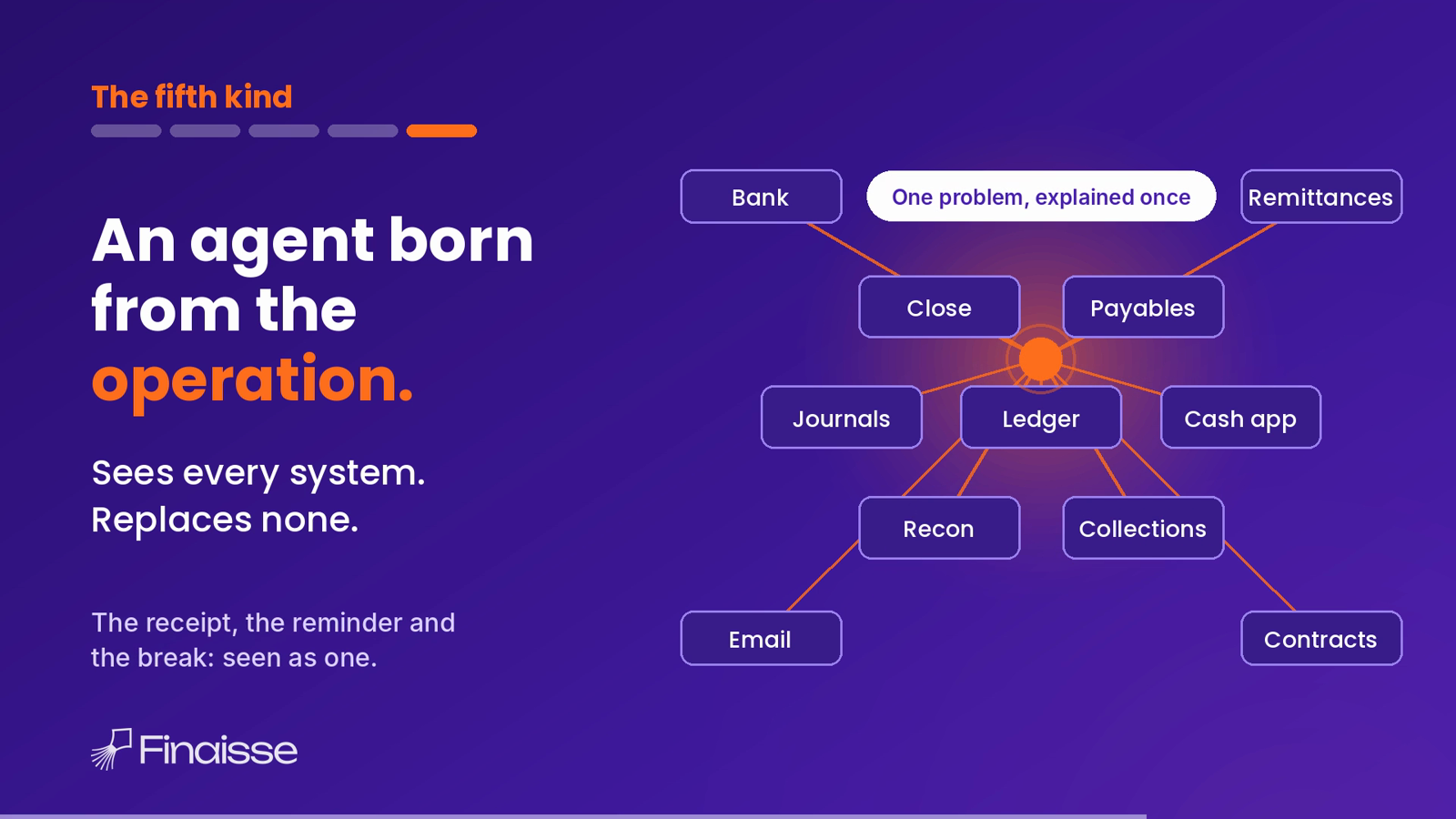
Imagine an agent that connects to your ERP without replacing it. That reads your bank feeds and remittance emails. That sees your reconciliations, your collections workflows, your close tasks. That understands the $48,000 receipt, the collection reminder, and the reconciliation break as one interconnected story rather than three separate events.
This isn't a hypothetical. It's the architecture behind the Connected Finance Platform we've built at Finaisse, with Finni as its intelligence layer. But the principle matters more than any single product: an agent that sees across systems can resolve problems that single-system agents will always escalate to humans.
The key architectural choices:
- Connects, doesn't replace. Your ERP stays your ERP. Your bank stays your bank. The agent reads from and writes to existing systems rather than requiring migration.
- Sees the operation, not just the record. Beyond transactions, the agent observes workflows — what's blocked, what's waiting, what depends on what. It understands not just what happened but what's supposed to happen next.
- Works within limits you set. Below your materiality threshold, for items it can explain and resolve reversibly, it acts and logs. Above the threshold, it prepares and a named person decides. You define the line. Evidence moves it over time.
How it works: the $48,000 scenario revisited
Return to the misapplied receipt. Here's how an operation-born agent handles it differently:
Day 3: The receipt arrives. Before auto-posting, the agent checks cross-system signals. It sees that Customer A has an open invoice for $48,000 — but also that Customer B has a nearly identical invoice, and the bank narrative includes characters that partial-match Customer B's name. The match confidence is 94%, but the ambiguity score is elevated. The agent flags the receipt for human review rather than auto-posting.
Day 3 (continued): A team member reviews the flag. The agent has already pulled the relevant context: both customer records, both invoices, the bank narrative, and a suggestion to check recent emails for remittance advice. The team member confirms Customer B, and the agent applies correctly. Total handling time: four minutes instead of three weeks of cascading problems.
Over time: The agent observes that Customer A and Customer B cause regular ambiguity. It recommends a customer master cleanup: merge the similar names, add distinguishing metadata. The root cause gets fixed, not just the symptom.
This isn't magic. It's what becomes possible when an agent can see across the same systems your team already uses — ERP, bank, email, customer master — without requiring any of them to change.
The trust equation: autonomy earned, not granted
An agent that sees across every system raises a legitimate concern: what stops it from doing too much?
The answer is that trust is earned, not assumed. The architecture should enforce boundaries:
Materiality lines — You define thresholds. Below a certain dollar amount, for actions that are explainable and reversible, the agent can complete work autonomously. A $600 reconciliation break traced to a timing difference gets resolved and logged. A $48,000 possible duplicate invoice goes to a named person with evidence attached. The line between autonomy and oversight is yours to draw.
Evidence requirements — Before acting, the agent must be able to explain why. Not a confidence score — an actual explanation linking the action to source documents. If it can't explain, it can't act. This isn't a limitation; it's the whole point. In finance, unexplainable automation is worthless.
Audit trails — Every action the agent takes, whether autonomous or human-approved, is logged with the reasoning and source references that supported it. When auditors ask *Why was this posted?*, there's an answer — even for the items no human reviewed.
Progressive expansion — You start narrow. Connect the agent to last month's close and let it observe. Give it one workflow — cash application into reconciliation — in prepare-only mode. As the evidence builds that it's getting things right, widen the scope. Thresholds rise because the record justifies them, not because a demo was impressive.
This is how AI earns trust in finance: not through bold claims, but through demonstrated competence on progressively harder work, with full visibility into what it's doing and why.
Three questions for any vendor — including us
Whether you're evaluating an ERP agent, a tool agent, an assistant, an AI-native ledger, or something that claims to be the fifth kind, these three questions cut through the marketing:
1. What can it see?
Not what can it access in theory, but what does it actually observe? Can it see the bank statement narrative and the customer email simultaneously? Can it trace a balance to source documents across systems? Does it have visibility into the workflows your team uses, or just the transactions they produce?
Ask for the $48,000 scenario. Show them a misapplied receipt that cascades into a collection complaint and a reconciliation break. See how their agent would handle it at each stage. If the answer involves three separate investigations in three separate systems, you're looking at bolt-on intelligence, not operational intelligence.
2. Who sets its limits?
Every agent claims to have guardrails. The question is whether you control them. Can you define materiality thresholds by account, by entity, by process? Can you restrict which actions it can take autonomously versus which require approval? Can you inspect the rules it's operating under?
Be wary of agents where the limits are opaque. *Don't worry, our AI is safe* is not an answer. *Here are the specific conditions under which it will act, here's how you modify them, and here's the audit trail of every time it did* — that's an answer.
3. Can you prove what it did?
After the agent runs for a month, can you show an auditor exactly what it did and why? Not aggregate statistics — specific actions. For every journal it posted, every match it approved, every exception it resolved: the evidence it relied on, the rules it applied, the outcome it produced.
This matters more than any capability claim. In finance, automation that can't explain itself is automation you can't use. If the audit trail is thin or the explanations are vague, the agent will be too.
Starting small: weeks, not a migration
The fifth kind of agent doesn't require replacing your stack. A reasonable adoption path:
Week 1-2: Connect and observe. Point the agent at your ERP, your bank feeds, your key reconciliations. Let it observe last month's close. It doesn't post anything — it just builds understanding of how your operation works.
Week 3-4: One seam, prepare-only. Pick the workflow where context gaps hurt most. Cash application into reconciliation is common. Let the agent prepare recommendations. Your team reviews and approves. You're seeing what it would do without letting it act.
Month 2+: Earned autonomy. As the agent's recommendations prove accurate, expand its scope. Lower-dollar items it resolves correctly move to autonomous. Higher-dollar items stay in human review. The boundary shifts based on evidence, not promises.
The real work in this process is writing down your policies. What should be auto-applied? What requires review? What are the materiality thresholds for different action types? Most teams have this knowledge distributed across people's heads. Making it explicit is valuable regardless of which agent you choose.
The visual version
We've condensed this framework into a five-minute video and a visual guide that walks through all four agent types, where the fifth kind fits, and how to apply the three evaluation questions. Share it with your team or use it in your next vendor conversation.
The decision that actually matters
The AI agent landscape in finance will keep evolving. New vendors will emerge. Existing vendors will ship more capabilities. The hype will intensify before it settles.
Through that noise, one architectural question matters more than any feature comparison: does the agent see what your team sees? Can it observe the full context of an exception — not just the transaction in one system, but the upstream cause and downstream consequences across systems?
If the answer is no, you're looking at incremental automation. Valuable, but bounded. The hard exceptions will still flow to your team because the agent can't see what's needed to resolve them.
If the answer is yes, you're looking at something different: intelligence that works at the operational level, across the boundaries where problems actually live. That's the fifth kind. And it's what finance has been waiting for.
Keep your ledger. Keep your tools. Keep your assistant. And give them one connected platform that sees the whole operation — because that's where the work is.
Meet Finni — the intelligence behind every finance workflow.